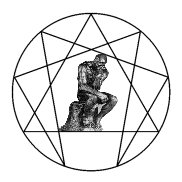
BTG XL

(RBN XL Belzebu conta como as pessoas aprenderam e em seguida esqueceram sobre a lei cósmica fundamental do Heptaparaparshinokh [BTG])

BTG XXXIX BTG XLI

XL. Beelzebub Tells How People Learned and Again Forgot About the Fundamental Cosmic Law of Heptaparaparshinokh (pgs. B813 - B870)

Chapitre 40 Belzébuth raconte comment les hommes connurent et oublièrent la loi cosmique fondamentale d’Heptaparaparshinokh

Capítulo 40 Belzebu conta como os pessoas aprenderam e de novo esqueceram sobre a lei cósmica fundamental de Heptaparaparshinokh.

**1. The Fundamental Dilemma of Human Understanding**

Beelzebub begins by addressing Hassein's perplexity about how Earth's three-brained beings, despite being burdened with “automatic Reason” since the second Transapalnian perturbation, could comprehend the sacred cosmic laws of Triamazikamno (Law of Three) and Heptaparaparshinokh (Law of Seven). He explains that while most humans operate with degraded, mechanical cognition, rare exceptions occur when individuals escape the maleficent influence of conventional education (*Oskiano*).

**2. Exceptional Cases of Objective Reason**

- Formation of True Reason: Some beings retain the potential for objective Reason when their early development occurs in relatively normal conditions, free from the distortions of mainstream education.

- Role of Conscious Guides: These rare individuals often have mentors who consciously impart knowledge while maintaining impartiality and activating the divine impulse of Conscience.

- Transmission of Knowledge: Such enlightened beings can discover cosmic truths and transmit them, though their insights are typically lost or distorted over generations.

**3. Historical Rediscoveries of Cosmic Laws**
**A. The Atlantean Origins**

- Theophany's Discovery: On Atlantis, the scientist Theophany first noticed that a particular mixture (Patetook plant resin, pine resin, and goat milk cream) always formed seven distinct plane surfaces when cooled, revealing the sevenfold nature of manifestations.

- Tazaloorinono: This led to the science of “seven-aspectness-of-every-whole-phenomenon,” which was lost when Atlantis sank.

**B. The Chinese Rediscovery**

- Choon-Kil-Tez and Choon-Tro-Pel: These twin brothers, descendants of an Atlantean scientist, rediscovered Heptaparaparshinokh while studying opium in ancient China.

- Key Findings:

Opium consisted of seven independent crystallizations, each containing seven sub-crystallizations ad infinitum.

- The same sevenfold structure appeared in white light (when diffracted) and sound vibrations.

- They identified two critical “gaps” (Mdnel-Ins) in the law's flow, naming them *Sooanso-Toorabizo* (“obligatory-gap-aspects”).

- Alla-Attapan Apparatus: They constructed an elaborate device with three parts:

Loosochepana: Analyzed light through prisms and diffraction.

- Dzendvokh: Studied sound via precisely tuned strings.

- Riank-Pokhortarz: Demonstrated harmonic interactions between light, sound, and opium's active elements.

**4. The Lav-Merz-Nokh and the Science of Vibrations**

- King-Too-Toz's Refinements: A later Chinese scientist expanded the brothers' work by creating the Lav-Merz-Nokh, a stringed instrument that mapped cosmic vibrations:

Seven Octaves: Representing the seven centers of gravity in the cosmic Ansapalnian-octave.

- String Types:

White Strings: Whole notes (Adashtanas, Evotanas, etc.), corresponding to the 7 fundamental vibrations.

- Black Strings: Half notes (*Demisakhsakhsa*), placed only where the Law of Seven permitted independent vibration.

- Hair Strings: Positioned at the “gaps,” producing chaotic vibrations influenced by environment and observer.

- Red Strings: Quarter notes (*Keesookesschoor*), adjustable to harmonize with the hair strings' unpredictability.

- Sacred Hanziano: The perfect consonance of all strings, mirroring the Nirioonossian-World-Sound (the fundamental vibration of the universe).

**5. Degeneration of Knowledge**

- Fragmentation: Over centuries, the complete science devolved into disconnected fragments:

Opium Chemistry: Methods to extract 42 active elements (e.g., morphine, codeine).

- Color Theory: Laws of color blending, preserved briefly by Persian artists.

- Music: The seven-tone scale, stripped of its cosmic significance.

- Modern Confusion:

Scientists like Gaidoropoolo futilely tried reconciling the Chinese 7-note and Greek 5-note systems, missing their entirely different origins (conscious discovery vs. vocal physiology).

- Contemporary humans use music for trivial entertainment, oblivious to its harmonic laws.

**6. Beelzebub's Practical Demonstration**

- The Piano as a Tool: Beelzebub explains that a piano, though a crude simplification, can still illustrate Heptaparaparshinokh:

Chord Progressions: Show how vibrations evolve and involve through the seven notes.

- Gaps: The intervals between *mi-fa* and *si-do* mirror the cosmic “gaps.”

- Vivifying Power: Properly tuned, the piano can demonstrate how vibrations gain potency through harmonic fusion (analogous to being-piandjichari, the second being-food).

- Limitations: Unlike the Lav-Merz-Nokh, the piano cannot fully replicate the sacred Hanziano or show interactions across multiple octaves of cosmic substances.

**7. Philosophical Implications**

- Loss of Being-Partkdolg-Duty: Humans forgot how to consciously assimilate knowledge (the third being-food), leading to:

Automatic Reason: Mechanized thinking devoid of true understanding.

- Superstition of Style: Valuing form over substance (as critiqued by Borges).

- Cosmic Irony: Earth's beings possess tools to comprehend universal laws but lack the consciousness to use them properly.

Beelzebub emphasizes that genuine knowledge requires:

- Conscious Labor: Intentional study and verification.

- Intentional Suffering: Overcoming mechanical tendencies.

- Transmission Through Initiates: Preservation by those who understand.

He prepares to give Hassein a hands-on demonstration using the piano, hoping to imprint the living laws of vibrations beyond theoretical explanation.

**Key Themes and Symbols**

- Heptaparaparshinokh: The sevenfold structure underlying all cosmic phenomena.

- Automatic vs. Objective Reason: The struggle between mechanical and conscious cognition.

- Gaps (Mdnel-Ins): Critical intervals where transformation occurs.

- Music as Metaphor: Harmonic laws mirror cosmic order.

- Degeneration: The tragic loss of ancient wisdom through distortion and forgetfulness.